




The latest data released on Thursday morning indicates that the US economy maintained a robust growth trajectory in the final quarter of 2023, albeit at a slower pace compared to earlier in the year.
According to the news release from the Bureau of Economic Analysis, the real gross domestic product (GDP) increased at an annualized rate of 3.3%. This figure is lower than the annualized rate of 4.9% recorded in the third quarter, as per the third estimate. However, it surpasses the forecasted rate of 2.0%.
The news release highlighted that the deceleration in real GDP during the fourth quarter, compared to the third quarter of 2023, was primarily attributed to slowdowns in private inventory investment, federal government spending, residential fixed investment, and consumer spending.
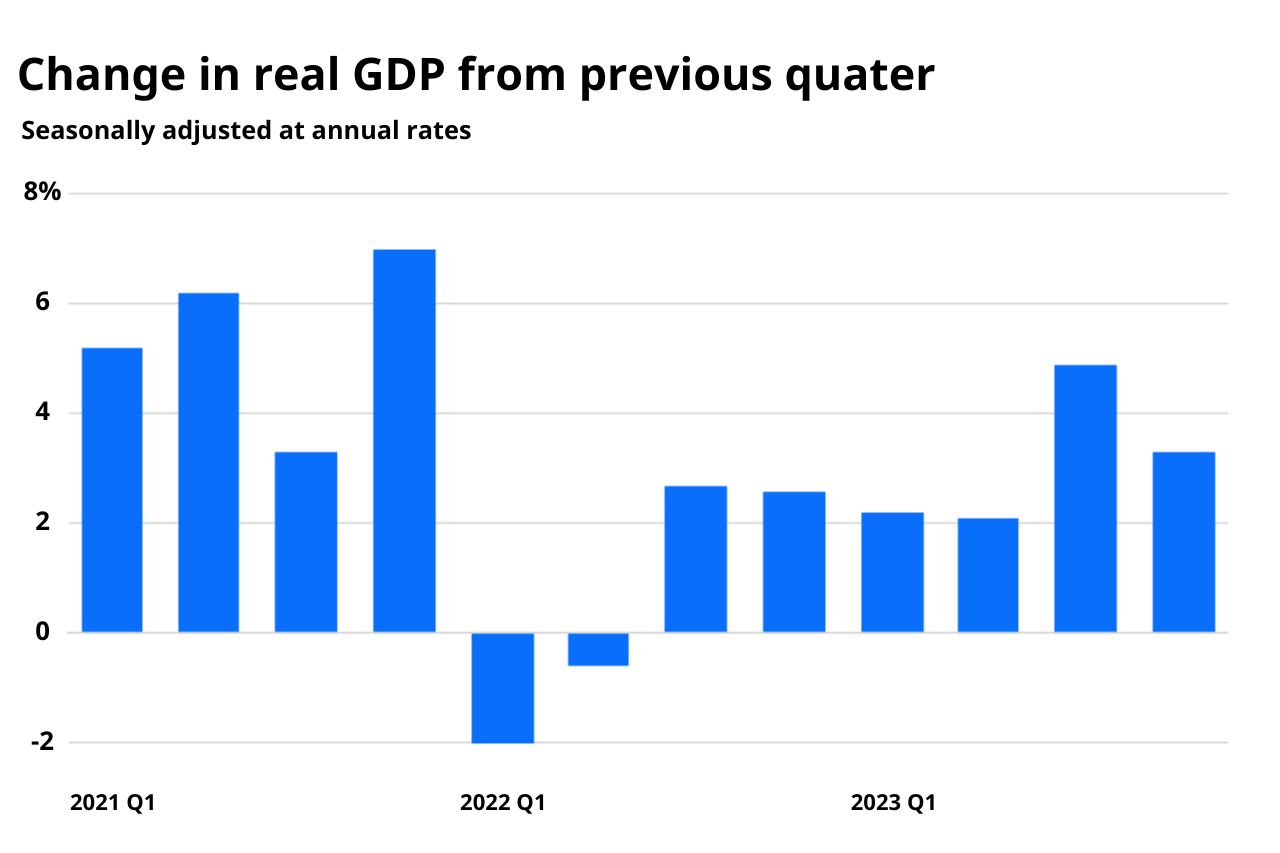
In the last quarter, various sectors experienced growth, with notable increases in exports and government spending.
The rise in real GDP was attributed to growth in consumer spending, exports, state and local government spending, nonresidential fixed investment, federal government spending, private inventory investment, and residential fixed investment, as stated in the news release.
Positive GDP figures over recent quarters indicate that the US has successfully avoided a recession. However, it’s crucial to consider multiple economic indicators, such as employment data, when assessing the business cycle.
According to the NABE Business Conditions Survey conducted from December 28, 2023, to January 9, 2024, a higher percentage of respondents express optimism about the country avoiding a recession. The survey reported that 91% of respondents assign a probability of 50% or less to the US economy entering a recession over the next 12 months, an increase from 79% in the October survey.
Steve Rattner, Chairman and CEO of Willett Advisors, stated in a recent Bloomberg interview that although he’s not predicting a recession, there are signs of the US economy weakening. He pointed out slight downturns in the job market, retail sales, and various stress indicators like savings rates, credit card usage, and subprime auto delinquencies.
Rattner acknowledged that the US economy was robust last year compared to expectations, partly due to increased purchasing power.
Despite smaller job growth, nonfarm payroll growth suggests a strong job market in the previous year. The Bureau of Labor Statistics reported that payroll employment increased by 2.7 million in 2023, with an average monthly gain of 225,000, compared to the increase of 4.8 million in 2022, with an average monthly gain of 399,000.
Overall, real GDP showed a more significant increase last year than in 2022, with a growth rate of 2.5% in 2023 compared to 1.9% in 2022. The surge in consumer spending was just one contributing factor to the overall increase in real GDP last year, according to the news release.
According to Business Insider
By. Pham Thanh Bien
You might enjoy:


