




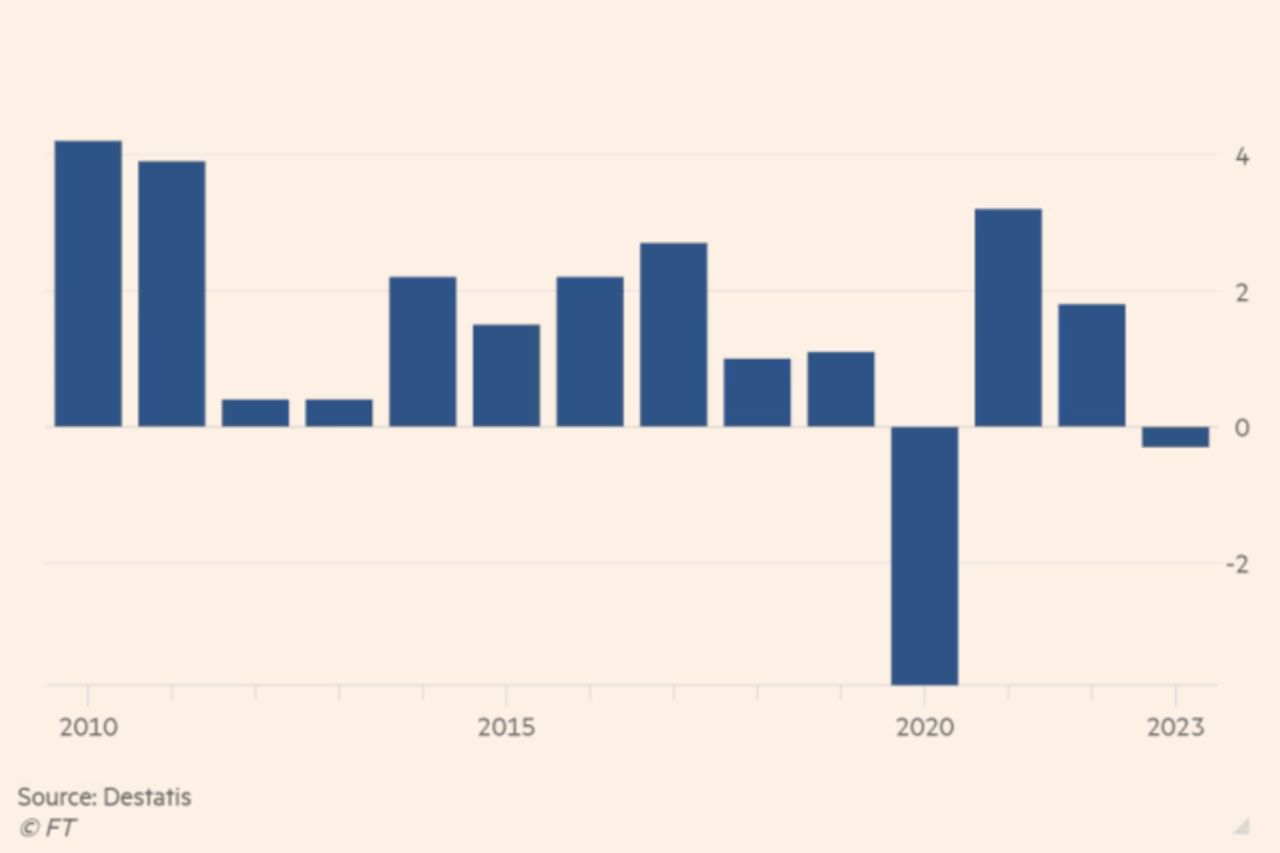
Germany experienced a 0.3% contraction in economic output in 2023, attributed to high inflation, increasing interest rates, and elevated energy prices. This development positioned Germany as the least robust among the major global economies, according to preliminary data released by the federal statistical office Destatis on January 15.
The outcomes mentioned have added more gloom to the start of 2024 for the largest economy in Europe. Upon entering the new year, Germany grappled with a nationwide railway strike related to working hours and witnessed protests from farmers opposing government reductions in fuel subsidies.
Ruth Brand, the President of Destatis, observed, “Overall economic growth in Germany reversed in 2023 in an environment marked by simultaneous crises”.
Negative growth but avoiding recession
Destatis reports that despite a decrease, Germany’s domestic Gross Domestic Product (GDP) in the past year remained higher than pre-pandemic levels, attributed to two consecutive years of growth in 2021 and 2022. In comparison to 2019, Germany’s GDP in 2023 is up by 0.7%.
This information coincides with another statistical report released on the same day, revealing a third consecutive monthly decrease in industrial output in the eurozone for November. Economic experts suggest these figures may indicate a potential contraction in the entire currency union in the fourth quarter of 2023.
Economist Melanie Debono from Pantheon Macroeconomics noted that while she initially projected a 0.1% contraction in the eurozone economy for the preceding quarter, the latest data suggests the actual decline might be more substantial.
According to the International Monetary Fund (IMF), Germany experienced the poorest growth performance among major global economies last year. A recent report from this Washington DC-based institution indicated that developed economies achieved an average growth rate of 1.5% throughout 2023, while emerging and developing economies saw a 4% growth.
As per IMF forecasts, the U.S. economy grew by 2.1% last year, the eurozone increased by 0.7%, and the UK’s economy expanded by 0.5%. This underscores how Germany, a significant manufacturing hub heavily dependent on exports, faced substantial challenges with the loss of a cost-effective energy supply from Russia and a deceleration in demand from China.
A report on January 15 from the European Union’s Eurostat revealed that Germany and Italy experienced the most significant declines in industrial output, leading to a 0.3% decrease in the overall industrial output of the eurozone in November compared to October, resulting in a total 12-month decline of 6.8%.
Germany’s GDP contracted by 0.3% in the fourth quarter compared to the third quarter, following a stagnant performance in the third quarter, according to Destatis. This implies a yearly contraction, but Germany managed to avoid a recession as a recession is defined by two consecutive quarters of negative growth.
Bleak prospects for Germany’s economy in 2024
Nevertheless, the data within Germany’s economic report for 2024 portrays a bleak scenario. Retail sales, exports, and industrial production all experienced declines. The nation’s households feel the impact of the sharply rising cost of living, while the manufacturing sector contends with pressure from escalating energy expenses, a global demand downturn, and increasing borrowing costs.
In the past year, household consumption in Germany saw a decrease of 0.8%, falling below pre-pandemic levels by 1.5%, as reported by Destatis. The value-added in industrial production, excluding construction, witnessed a 2% decline. Government expenditure also dropped by 1.7% as pandemic-related stimulus measures concluded.
As per the Organisation for Economic Co-operation and Development (OECD) forecast, Germany’s economy is projected to grow by a modest 0.6% in 2024, maintaining its position as one of the weakest among major global economies. Several analysts revised down their economic growth predictions for Germany following the government’s reduction in public spending plans to address a 60 billion euro budget deficit.
Economist Andrew Kenningham from Capital Economics notes, “The prolonged recessionary pressures from late 2022 will persist into this year,” anticipating zero growth for the German economy in 2024.
Despite this, economists anticipate a slight recovery in consumer spending in Germany this year, driven by the rebound in household purchasing power as wages continue to rise robustly and inflation subsides.
While inflation in Germany has decreased from over 11% at the end of 2022 to 2.3% in November 2023, prices in the country remain elevated compared to pre-pandemic levels. In December 2023, inflation in Germany increased to 3.8% after the government removed energy price subsidy policies.
“Despite the recent slowdown in inflation, prices remain elevated across all stages of the economic process, posing a challenge to economic growth,” expressed Ms. Brand.
In the effort to combat inflation, the European Central Bank (ECB) has raised interest rates to a record high of 4%, resulting in the highest borrowing costs for the German economy in a decade. Elevated interest rates have dampened demand in the industrial sector and led to a 10% decline in housing prices in Germany.
“Unfavorable financial conditions arising from high-interest rates, weak domestic demand, and feeble external demand collectively exert pressure on economic growth,” emphasized Ms. Brand.
While there is a marginal improvement in November’s export data for the eurozone, with an overall export volume increase of 1% compared to the previous month and a 0.6% decrease in imports, year-on-year figures reveal a 4.7% decline in eurozone exports and a substantial 16.7% drop in imports, reflective of the decreasing energy and food imports.
According to Reuter.
By. Pham Thanh Bien
You might enjoy:


