




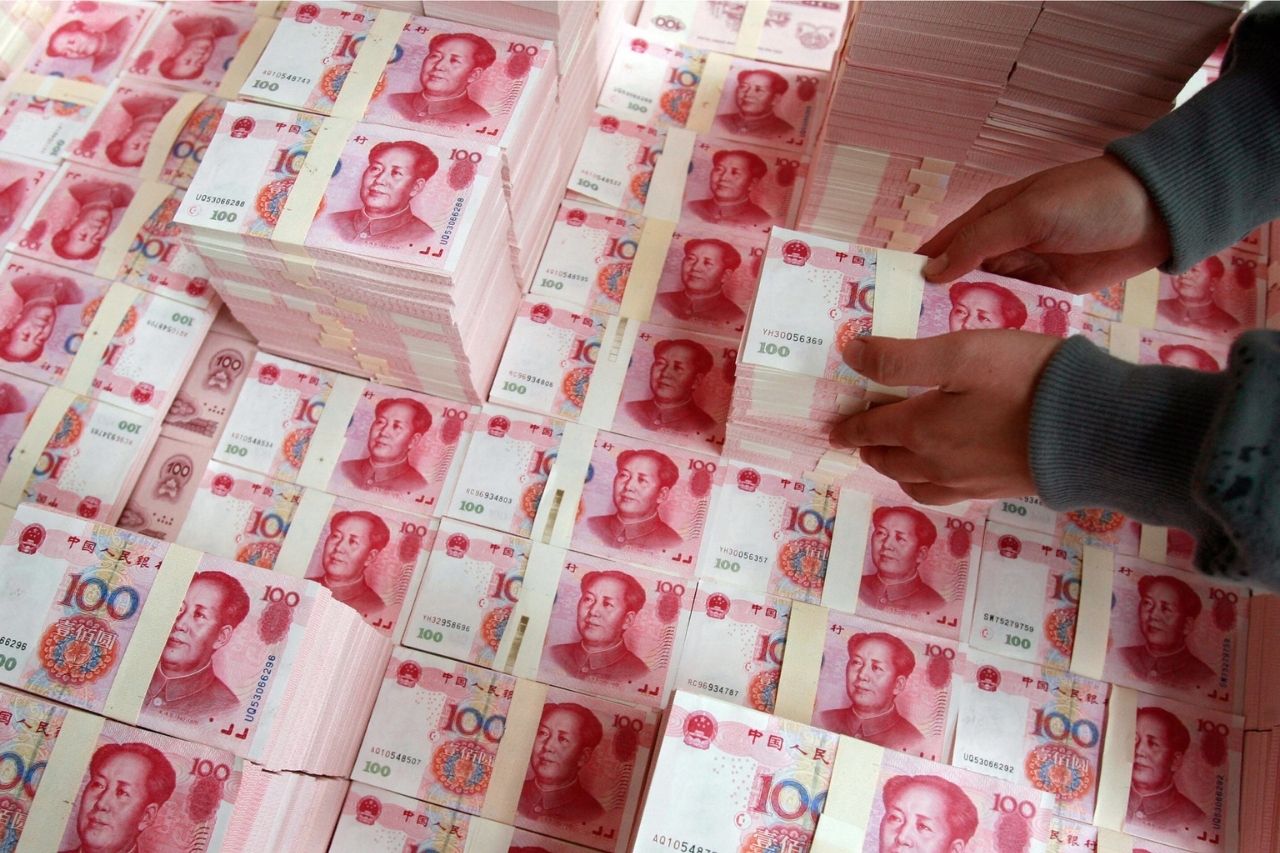
Investors are seeking defensive measures in anticipation of the Chinese yuan (CNY) potentially depreciating as the second-largest global economy gears up for a return to normalcy after an extended Lunar New Year holiday.
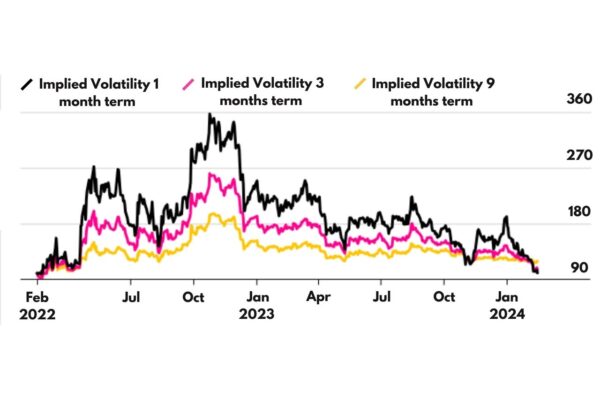
The implied volatility across all timeframes has hit its lowest point since 2022, making options the most cost-effective means of protection against the potential significant devaluation of the CNY.
In the case of the offshore yuan, short-term implied volatility has decreased from its peak in October 2022. The implied volatility for 1-month and 3-month periods is currently at its lowest level in two years, enabling option buyers to obtain protective measures at a more affordable cost to guard against the risk of a more substantial CNY depreciation than anticipated.
While the implied volatility for the 9-month term, aligning with the U.S. presidential election on November 5th, hasn’t decreased as much as shorter-term durations, it is presently trading around 5.3%, nearing the lows observed in August 2022 before experiencing a surge.
Brent Donnelly, the President of Spectra FX Solutions LLC and a seasoned forex trader with experience at HSBC, Citigroup, and Nomura, remarked that all political perspectives are currently critical of China.
He recommended clients to purchase 1-year USD/CNH call options at a rate of 7.60 when the pair was trading at 7.2250 in early February. This is considered an effective and low-cost hedging strategy, regardless of the outcome in November.
Donnelly highlighted China’s economic challenges, leading to currency struggles, where depreciation seems more likely than appreciation due to limited options.
In agreement with this view, Societe Generale analyst Kiyong Seong suggested clients seize the opportunity presented by the “lowest prices in years” and acquire 3-month USD/CNH call options as a safeguard against potential depreciation.
The low volatility of the CNY is primarily attributed to the People’s Bank of China (PBOC) anchoring the rate, maintaining relative stability in the exchange rate for several months, as per experts from the French bank. Seong pointed out that the currency is permitted a 2% fluctuation in either direction from the daily reference rate, and if the CNY weakens beyond 7.25, it would be “unavoidable” for the central bank to devalue.
In the event of a market downturn, the subsequent reaction is expected to be robust, propelling USD/CNH towards 7.30-7.35, where substantial resistance is anticipated.
Last week’s U.S. data also revealed sustained inflationary pressures, reducing optimism for the Federal Reserve (Fed) to implement interest rate cuts in the first half of 2024. This has intensified pressure, leading to a depreciation of the Chinese yuan.
Citigroup, Societe Generale, and former U.S. Treasury Secretary Larry Summers have all recommended investors brace for the potential scenario of the Fed raising interest rates instead of the previously anticipated rate cuts.
You might enjoy:


 potentially depreciating)