





M2 Money supply
The “M2 money supply” is a term in economics and finance referring to the amount of money provided in the financial system of a specific country or region within a certain period.
“M2” is an index measuring the money supply in the financial system, which includes the total cash (currency in circulation and cash in bank vaults) plus demand deposits, savings deposits, and short-term time deposits.
M0 (Cash): M0 refers to the total amount of cash in the economy, including all types of currency that the public holds and uses on a daily basis.
M1 (Cash and Demand Deposits): M1 expands on M0 by including both cash as well as demand deposits that are easily withdrawable from bank accounts. This includes cash along with the amount in bank accounts that can be withdrawn via means such as checks, debit cards, or bank transfers.
Role of M2 money supply in the economy
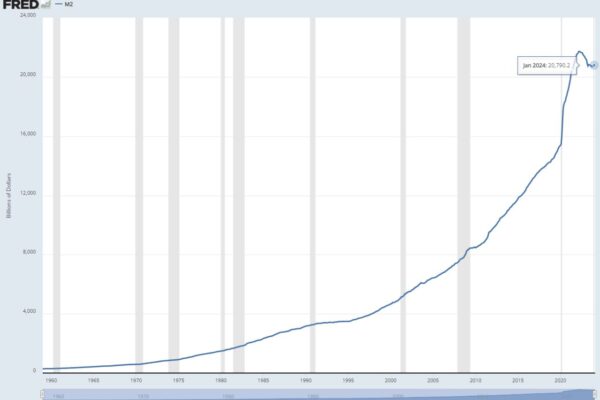
In the complex context of the world economy, the M2 money supply plays a crucial role in various aspects. Here are some key roles of the M2 money supply:
1. Assessing the monetary situation
M2 money supply provides valuable information about the amount of cash and cash-equivalent assets available in the financial system. By evaluating the M2 money supply, the government, central bank, and policymakers can have a better understanding of the country’s monetary situation and implement appropriate measures.
Suppose a country is facing an economic recession, and the central bank decides to increase the M2 money supply by reducing interest rates. As a result, the amount of cash and deposits that can be easily withdrawn from banks increases, thereby stimulating consumer spending and investment.
2. Forecasting economic growth
The growth of the M2 money supply often significantly influences economic activities. An increase in M2 money supply can lead to economic growth as consumers and businesses have more money to spend and invest. Conversely, a decrease in the M2 money supply may cause a decline in economic activities.
To understand further, a significant increase in the M2 money supply may result from the growth of borrowing and credit activities, and forecasting growth in the M2 money supply can lead to positive forecasts of economic growth in the future.
3. Supporting monetary policy decisions
Data on the M2 money supply is one of the critical factors used to make decisions about monetary policy. Governments and central banks often use information about the M2 money supply to decide whether to raise or lower interest rates, scale stimulus measures or credit restrictions, and maintain economic stability.
If the M2 money supply increases too rapidly and causes inflationary pressures, the central bank may decide to raise interest rates to curb the growth of the money supply and control inflation.
4, Forecasting Inflation
Rapid growth in the M2 money supply can create inflationary pressures in the economy. Monitoring and forecasting the M2 money supply are essential parts of assessing inflation risks and implementing preventive measures.
If the M2 money supply increases rapidly, accompanied by rapid credit and spending growth, it may lead to rapid price and inflation growth.
5. Shaping Consumer and Investment Behavior
The M2 money supply can influence the consumer and investment behavior of individuals and businesses. A large M2 money supply often accompanies increased consumer spending and investment, so a decrease in the M2 money supply may reduce consumer spending and investment.
If the M2 money supply increases, there is more money in the economy for spending and investment. This can stimulate consumer and business spending and investment, leading to economic growth. Conversely, a decrease in the M2 money supply may reduce consumption and investment.
Impact of money supply on the economy
Positive
1. For the government
- Economic growth: An increase in the M2 money supply can stimulate economic growth by providing more capital for investment and consumption activities.
- Inflation control: The government can use monetary policy measures to control inflation, adjusting the M2 money supply accordingly to ensure price stability.
- Credit support: Increasing the M2 money supply can also help the government support credit for businesses and individuals, especially in times of economic hardship.
2. For the people
- Consumption and investment: The increase in the M2 money supply often accompanies increased consumption and investment from individuals and businesses, stimulating economic activity and creating more business opportunities.
- Financial support: Increasing the M2 money supply can provide more financial options for consumers and businesses, such as borrowing or investing in new projects.
Negative
1. For the government
- Inflation: Rapid growth in the M2 money supply can lead to inflation, causing currency devaluation and weakening purchasing power for consumers.
- Financial bubble: When the M2 money supply increases rapidly without accompanying economic growth, it can create financial bubbles, causing asset prices (such as real estate or stocks) to rise unsustainably and leading to a collapse in asset prices, resulting in negative consequences for the economy.
2. For the people
- Inflation: Consumers and businesses will face currency devaluation, leading to reduced purchasing power and affecting their lives and business activities.
- Financial risk: Uncontrolled increases in the M2 money supply can create financial risks for borrowers when debt levels become disproportionate to their repayment ability.
Remedial measures
- Government: Implement monetary policy measures to control the M2 money supply, strengthen supervision and management of financial risks.
- People: Enhance knowledge and awareness of personal finance regarding economic cycles, basic market knowledge, optimize financial management, and seek long-term beneficial investment opportunities.
You might enjoy:


